
Introduction
In the present-day corporate scenario where time is very much of essence, workforce management has become one of the most significant elements for organizational success. In case of SMEs (Small & Medium Enterprises), effective human resource management is directly related to the bottom-line profits of the enterprise. As compared to big firms, small firms operate under constrained budgets and schedules with small teams with Biometric Attendance System.
Unfortunately, many startups and small office setups still rely on old attendance systems—for example as manual registers, punch cards, or basic spreadsheet logs. These traditional systems are highly prone to human errors, compliance risks, and time fraud. Upgrading to a modern Biometric Attendance System is no longer a luxury reserved for big corporations; it is an absolute operational necessity. Let’s dive deep into how biometric technology can revolutionize and benefit small business operations.
What is a Biometric Attendance System?
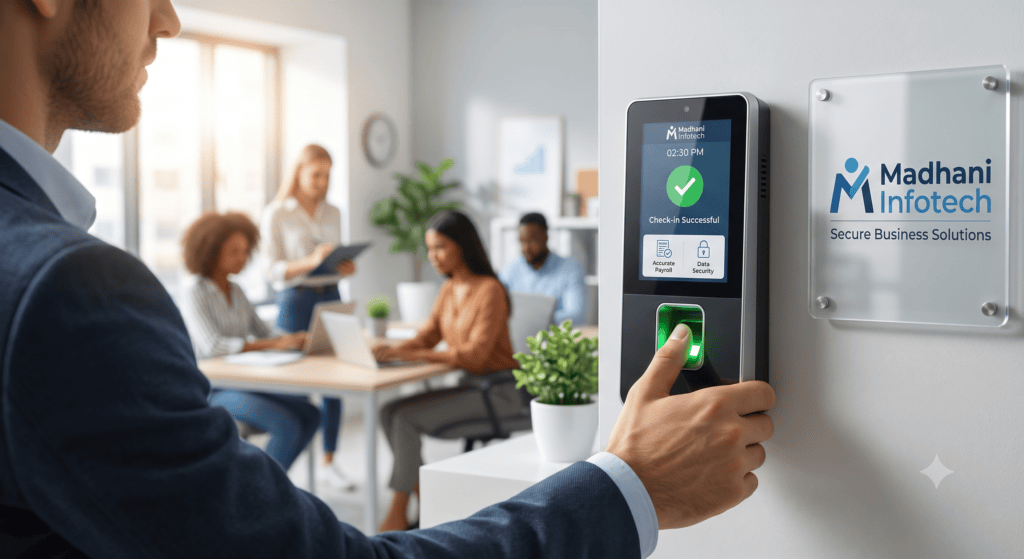
Before looking at the benefits, it’s important to understand what a biometric system does. Rather than relying on an ID card an employee has or something they can remember (like a password), biometrics rely on unique biological characteristics – such as fingerprints, facial structure, iris patterns, or hand geometry – to verify identity. When integrated with attendance software, it records the exact milliseconds an employee enters or leaves the office premises.
The Major Benefits for Small Businesses
1. Elimination of “Punching” and Time Theft
Time theft is a silent profit killer in small businesses. One of the most common forms of time fraud is punching, a practice where an employee clocks in or out on behalf of a colleague who is running late or entirely absent.
- With a traditional magnetic swipe card or PIN code, sharing credentials takes a second.
- Biometric data is unique to each individual. A fingerprint or face cannot be borrowed, shared, or duplicated.
- By introducing biometric authentication, small businesses can ensure that the person logging into the system is physically standing in front of the scanner. This completely eliminates time fraud and saves businesses thousands of dollars annually that would otherwise be wasted in unworked hours.
2. Basically in the payroll process
Ask any small business accountant or HR manager, and they will tell you that payroll week is one of the most stressful times of the month. Manually calculating hours, subtracting time for late arrivals, adding overtime, and accounting for half-days is a recipe for human error.
- The biometric system fully automates this workflow. It records precise time logs down to the exact second.
- This automated log can be directly integrated with your payroll and bookkeeping software.
- As a result, your accounting team does not need to manually cross-verify physical logbooks. Employees are paid accurately for the time they clock in, which greatly reduces internal disputes over pay.
3. Transform a Culture of Punctuality and Accountability
When employees know that a smart machine is tracking their time and attendance with absolute accuracy, it naturally changes workplace behavior. It eliminates ambiguity or excuses like “I come in at 9:00 AM but forgot to sign the register until 9:30 AM.”
Biometrics creates an environment of mutual accountability. It rewards employees who arrive on time and provides clear, undisputed data on employees who are chronically late, allowing management to take necessary action based on actual records rather than personal attributions.
4. Advanced Workplace Security and Access Control
For a small business, protecting physical assets, inventory, client data, and server rooms is crucial. Most modern biometric attendance systems act as access control systems. This means you can restrict physical access to specific rooms or zones in your office. For example, only certified technicians can unlock a server room with their fingerprint, or only the accounting team can access a key secure area. This keeps unauthorized visitors or even lower-level staff out of restricted zones, which increases the overall security posture of your facility.
5. Seamless Scaling and Cloud Integration
Small businesses are on the move. As your team expands from 5 employees to 50 or 100, manual logbooks become completely unmanageable. Biometric attendance systems are designed to scale easily. Modern systems offer cloud-based dashboards, allowing business owners to monitor staff attendance across multiple office branches or store locations in real-time from a single mobile app or web portal.
Conclusion
From old-fashioned attendance tracking to a digital biometric system is an important milestone in a small business’s digital transformation journey. It saves money, eliminates time theft, streamlines payroll, increases overall productivity, and secures your workplace. By using high-quality biometric hardware, you lay a solid foundation for a modern, efficient, and highly professional corporate infrastructure.